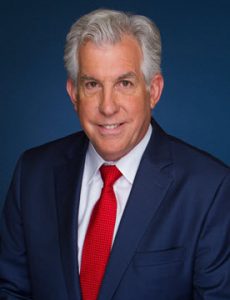
Andrew Demetriou
Long before Andrew Demetriou became a partner at Lamb & Kawakami, a prestigious law firm in Los Angeles, he spent hours Bunche Hall like the thousands of students currently at UCLA. His subsequent career as a successful attorney in the healthcare industry is a testament to his intellectual curiosity, dedication, and passion for economics and law.
At Van Nuys High School, Andrew joined the speech and debate team and during his senior year the national debate topic concerned reform of the American jury system. As a result, he was introduced to law and the legal system and spent hours in UCLA’s Law Library, learning techniques for legal research. This experience was important in directing his ultimate career path.
Upon arriving at UCLA, Andy began studies in Economics, drawn by the rigorous problem solving approach to social problems of allocation of resources. He also gained insights into business organizations and the function of the broader economy. He joined the UCLA Debate Union, serving as its President in 1975-76, and established himself as a member of UCLA’s top team in his junior and senior years, twice qualifying for the National Debate Tournament. Andrew believes that his success in debate, and later as a lawyer, was bolstered by the critical thinking skills he acquired in his Economics classes.
After graduating from UCLA summa cum laude, Andrew went on to UC Berkeley to pursue his law degree. His law schools studies contrasted with undergraduate work due to the expectations of mastery over intricate details and demanding subject matter. He believes that his undergraduate studies in economics, coupled the research and thinking skills used in his debate career prepared him for such work and contributed greatly to his understanding of law. He notes that a lot of successful law students have economics or math backgrounds because these fields teach problem solving skills, and many aspects of the law address issues of risk allocation and responsibility, which are not unlike the allocation of resources in an economic system.
In the course of his law practice he was a partner at two major international firms, where he experienced a trend toward specialization and industry focus, dictated by demands from clients for deep understanding of their business models and financial needs. In the early 1990s, Andy began to focus on the health care industry, which had undergone enormous changes in the preceding decade, from a balkanized industry, dominated by standalone hospitals, therapy centers, and clinics, and small physician practices. The 1990s witnessed the emergence of large health organizations combining groups of providers and facilities, coupled with increased federal and state regulation of industry participants. For the last quarter century, Andrew has represented health care providers in a wide range of corporate and regulatory matters. He is especially proud of having represented the UCLA Health system for several years, including the negotiation of the between Santa Monica Hospital and UCLA Medical Center and the affiliation between UCLA Health System and Orthopaedic Hospital of Los Angeles, bringing world class orthopedic care into the UCLA system.
Today, Andrew is one of the leading lawyers in the healthcare industry. He attributes his success primarily due to his sound understanding of the industry and the clients he works with. Most clients come with technical questions in mind and he has to understand their problem, explain the legality of their issue, and develop a reasonable and applicable solution. Business law, unlike litigation, is not about ‘winning’ but rather about understanding the client’s risk tolerance and delivering solutions calibrated to the client’s risk sensitivity. Successful lawyers must understand the demands of the client.
Aside from his law practice Andrew has always been active in volunteer activities in the community. At age 29, he served as Chief Protocol Officer for the Swimming, Diving and Synchronized Swimming events in the 1984 Summer Olympics. His has devoted many hours of service to UCLA, as a member of the UCLA Foundation Board of Trustees and Board of Directors, Co-Chair of the UCLA Fund (from 1995-1999), an original member of the Board of Visitors of the Department of Economics and a member of the UCLA Athletic Hall of Fame Selection Committee. He has been active in a wide range of local state and national bar association activities, and served as Chair of the American Bar Association Health Law Section in 2007-08. Currently, he is advising a Presidential Commission, which includes members of the United States Senate, the House of Representatives and leading private citizens, charged with the construction of a memorial to President Dwight Eisenhower in Washington DC.
We asked Andrew about what advice he would give to current UCLA students and he posits that students have to be intellectually curious in whatever activity they pursue. He recommends that we use the freedom we have in college to gain new experiences. Most importantly, avoid the mercenary attitude of taking a linear path and fixating on making money as the end goal. Find opportunities that challenge your beliefs—ones that push you to learn and create new and more dynamic beliefs. Embrace the learning experiences these opportunities provide as a means of self-improvement.
By Harsh Gupta, with Adithya Kumar and Charles Qian.


Econ Concentration – Finance – Value Investing in a Market Economy
/in Uncategorized /by adminOne of the central functions of investors in a market economy is to direct capital to its most productive use. This concentration in Value Investing in a Market Economy is intended to prepare students for a wide range of careers in which they will be faced with the challenge of evaluating investment opportunities and making active decisions to direct capital to enhance value. Such careers include high level executive positions within companies, careers in alternative investment firms such as private equity or distressed debt firms, or in actively managed mutual funds. A student graduating from this concentration should be able to understand the full set of fundamental economic and strategic forces that favor or disfavor a particular investment opportunity from both a theoretical and historical perspective.
Prerequisites: In addition to the full set of lower division requirements for the Economics or Business Economics Major, a student in this concentration must also take Economics 101, 102, and 103/103L, and Mangement 120A and Management 120B.
Upper Division Electives: A student completing this concentration must complete four courses from the following list:
Econ 106F (Corporate Finance) Parick Convery and Ed McDevitt
Econ 106P (Pricing and Strategy) John Riley
MGMT 180 (Real Estate Finance and Investment) Mark Karlan
MGMT 126 (Financial Statement Analysis) various
Econ 165 (History of Capitalism in the American Economy) Lee Ohanian
Econ 181 (Development of Economic Institutions in Western Europe) Michela Giorcelli
Econ 187 (History of Financial Crises) Andy Atkeson and William Simon
Econ 187-2 (Value Investing) William Simon
Capstone Course:
Applied Value Investing: Econ 187-3 William Simon
Associated Bruin Development Academies to be shared by the two concentrations in finance:
– Financial modeling with Excel
– Valuation
Associated Internship Programs to be shared by the two concentrations in finance:
– Sharpe Fellows
– Simon Fellows
Associated Support for Faculty and Graduate Student Research:
UCLA has a strong tradition in Macroeconomics, Economic History, and Industrial Organization and in the integration of these fields. We see it as particularly important that students in this concentration be able to draw insights from all of these disciplines in understanding the drivers of economic value from a macroeconomic, historical, strategic, and regulatory perspective. We need funding to support and grow our faculty and graduate programs in these areas to meet the tremendous demand from students in this area.
Adriana Lleras-Muney elected to Executive Committee of AEA
/in News /by adminWe are pleased to announce that Adriana Lleras-Muney has been elected to the Executive Committee of the American Economic Association for a three-year term beginning January 7, 2018. The AEA is the profession’s most important society, publishing seven economics journals, and having over 18,000 members.
Moritz Meyer-ter-Vehn on AER Editorial Board
/in News /by adminMoritz Meyer-ter-Vehn joined the editorial board of the American Economic Review, one of the profession’s “top-5” journals, as an associate editor. He will be working with co-editor Jeff Ely on submissions in pure and applied economic theory.
David K. Levine
/in Alumni Interview /by Jerry LiuDavid K. Levine
Professor David K. Levine graduated from UCLA in 1977, earning a dual degree of Bachelors in Mathematics and a Masters in Economics. He was enrolled as a UCLA student during high school, but he later studied at Harvard University for a year before coming back to UCLA in his second year and finishing his degrees. He decided to be an economics professor since he was a freshman, because his initial education in economics was poor, as the economic consensus that he was taught seemed to defy common sense. He enrolled at UCLA as a math major while still taking economics courses because he believed a rigorous math background would help him conduct economic research. Eventually, he enrolled in graduate courses in economics as well after being convinced by his life-long mentor Professor Jack Hirshleifer. Professor Levine felt that there was major space for improvement in the field. Eventually, his motivation to improve economics and impart knowledge to others caused him to enter academia which led him to where he is today.
Although UCLA has a reputation for being a large and impersonal place, professor Levine’s experience here was quite the opposite. During his time as a student, there were very few math majors so it was easy to establish contact with other math majors and the faculty. Professor Levine was also given a key to the Math Library, which was his favorite place on campus and where he would often be found solving mathematical problems. Likewise, he had the opportunity to interact and learn from other economics graduate students when pursuing his dual degree. Crucially, he was also a research assistant to Professor Jack Hirshleifer, a professor emeritus of economics at UCLA and received lifelong mentorship from him. For Professor Levine, UCLA offered a great amount of resources that helped him become successful after graduation.
Professor Levine has garnered a long list of achievements throughout his career: He currently serves as joint chair for Department of Economics and Robert Schuman Center at the European University Institute. He is also the John H. Biggs Distinguished Professor of Economics Emeritus at Washington University in St. Louis. But he never kept such achievements in mind as he pursued economics; his motivation was always to push the frontier of this field and to advance the areas of economics he was most interested in.
When asked about the secret to conducting successful research, Professor Levine contends that it is necessary to come up with different explanations for economic phenomena and to determine their feasibility. At the heart of it, he states that common sense is absolutely necessary when conducting economic research. To this point, he brings up the example of intellectual property. The Disney Corporation controls copyrights in the US. Interestingly enough, the costs to the public due to copyrights are much greater than their benefits to Disney. Despite this, the reason why the public does not scrutinize Disney is because the cost per person is trivial. Thus, the public has little incentive to lobby against Disney. However, Professor Levine adds that this conclusion might not be so straight forward without a rigorous mathematical model to back it. He states that the general consensus amongst economists is to make lobbying more expensive or illegal to prevent Disney from lobbying extensively for maintaining control over copyrights. However, from his research alongside Professor Michele Boldrin, they concluded that lobbying should instead be made cheaper. They argue that Disney is able to lobby extensively because Disney makes it harder for the public to lobby against them. Making lobbying cheaper could therefore incentivize the public to actually take action. He drives the point that economic theory forces economists to look at the whole picture instead of erroneously looking at just a single piece of it.
Although our interview did not delve in depth into Professor Levine’s research (Readers can learn more about him and his research at http://levine.sscnet.ucla.edu/david.htm) we did talk about two of his books. The first book, Against Intellectual Monopoly, was co-written with Michele Boldrin. Together, they argued against intellectual property like copyrights and patents, for stifling innovation and competition instead of encouraging it. In the mid 90’s, economists typically viewed intellectual property as a necessary evil because, although it gave rise to monopolies, it was required to innovate. Before professors Levine and Boldrin set out to research innovation, they too shared the same view. However, after building general equilibrium models to study innovations across the economy, they soon found that this view was false. After spending years researching various empirical studies, they concluded that the importance of intellectual property in driving innovation was overstated, proving that even without monopoly power, there was incentive to innovate. The second book, Is Behavioural Economics Doomed?, addresses the backlash against mainstream economics for failing to consider the irrationality of human nature and the rising influence of behavioural economics. Having worked in the field of behavioral economics over the years, Professor Levine noted that there were many good and bad economic theories established in the discipline. His book presents a grim outlook on the field of behavioral economics, not because the discipline is failing but because he recognizes that eventually the good theories of behavioral economics will be incorporated into mainstream economics while the bad theories will be discarded.
Lastly, we asked him to give current undergraduate students some advice. His advice was simple: take full advantage of the resources that UCLA offers before graduating. There is always time to specialize later on so students should feel free to take classes that appeal to them even if it is not relevant to their major. Drawing from personal experience, despite pursuing a dual degree in math and economics, professor Levine took a wide variety of classes ranging from history to Russian. That’s the beauty of UCLA’s holistic curriculum: the opportunity to learn subjects that you wouldn’t otherwise get a chance to learn upon graduating. Remember to make the most of your education.
By Ng Xiang Yang, with Adithya Kumar and Charles Qian.
Understanding Network Formation
/in Research Spotlight /by Jerry LiuShuyang Sheng
Social and economic networks permeate our lives. They play an important role in determining how diseases spread, which products we buy, how much education we attain, and even whether to smoke. Since social and economic networks are central to our economic well-being, economists have recently become increasingly interested in exploring how social and economic networks are formed. They raise empirical questions such as which network structures are likely to emerge, why some people have many friends while others are isolated, and whether people with similar socioeconomic status are more likely to become friends.
Answering such questions is challenging. Social and economic networks are not formed randomly. We choose our friends on the basis of the utility from friendships. When we make such decisions, we also take into account the other friends we already have or other friends our potential friends already have. For example, we are more likely to add someone as a friend on Facebook if we have friends in common. Such an effect of indirect friends creates strategic interactions among individuals, posing a big challenge to the econometric analyses of network data. Moreover, social and economic networks typically have hundreds or thousands of individuals. Since the number of network structures increases exponentially in the number of individuals, traditional econometric methods often become computationally intractable when networks are large.
In her ongoing research entitled “Estimation of Large Network Formation Games” joint with Geert Ridder (USC), Professor Shuyang Sheng develops new econometric methods to estimate network formation models with strategic interactions that overcome these challenges. Professor Sheng characterizes network formation as a simultaneous-move game with incomplete information which allows for utility externalities from indirect friends such as friends of friends and friends in common. Because the expected utility is nonlinear in the link decisions of an individual, each individual faces a complicated discrete choice problem with a large number of overlapping alternatives, which is difficult to solve. The insight of Professor Sheng’s work is to use the Legendre transform to express the expected utility as a linear function of the link decisions of an individual, so the optimal link decisions can be derived in closed form. Using this closed-form expression, Professor Sheng proposes a two-step procedure to estimate the parameters, which has good asymptotic properties and is easy to compute.
The methods proposed by Professor Sheng can be used to answer empirical questions in social networks such as how demographic and socioeconomic composition of students in a school affects their social networks, and whether friends in common play a significant role so the networks represent a feature of clustering. Besides social networks, the methods can also be used to investigate the formation of economic networks. For examples, citations are widely used to measure the economic value of a patent. Viewing patent citations as a network among inventors, one can use the methods to examine empirically why some patents receive many citations while other do not, whether inventors tend to cite patents whose inventors are not far from them, whether citation networks represent clustering and why, and so forth.
William Zame elected fellow of Game Theory Society
/in News /by adminThe Economics Department is pleased to announce that William Zame has been elected as a fellow of the Game Theory Society. According the to Society’s bylaws, “The Fellows of the Society are a group of people honored for their contributions to game theory and service to the Society, and are a source of advice for the Steering Committee.” Fellows are elected by the council members of the GTS.
Michela Giorcelli wins Alexander Gerschenkron Prize
/in News /by adminProfessor Michela Giorcelli was awarded the Alexander Gerschenkron Prize for her dissertation “Economic Recovery and the Determinants of Productivity and Innovation: Evidence from Post-WWII Italy”. The Alexander Gerschenkron Prize is annually awarded by the Economic History Association for the best dissertation in economic history of an area outside of the United States or Canada. Congratulations!
Andrew Demetriou
/in Alumni Interview /by Simon BoardAndrew Demetriou
Long before Andrew Demetriou became a partner at Lamb & Kawakami, a prestigious law firm in Los Angeles, he spent hours Bunche Hall like the thousands of students currently at UCLA. His subsequent career as a successful attorney in the healthcare industry is a testament to his intellectual curiosity, dedication, and passion for economics and law.
At Van Nuys High School, Andrew joined the speech and debate team and during his senior year the national debate topic concerned reform of the American jury system. As a result, he was introduced to law and the legal system and spent hours in UCLA’s Law Library, learning techniques for legal research. This experience was important in directing his ultimate career path.
Upon arriving at UCLA, Andy began studies in Economics, drawn by the rigorous problem solving approach to social problems of allocation of resources. He also gained insights into business organizations and the function of the broader economy. He joined the UCLA Debate Union, serving as its President in 1975-76, and established himself as a member of UCLA’s top team in his junior and senior years, twice qualifying for the National Debate Tournament. Andrew believes that his success in debate, and later as a lawyer, was bolstered by the critical thinking skills he acquired in his Economics classes.
After graduating from UCLA summa cum laude, Andrew went on to UC Berkeley to pursue his law degree. His law schools studies contrasted with undergraduate work due to the expectations of mastery over intricate details and demanding subject matter. He believes that his undergraduate studies in economics, coupled the research and thinking skills used in his debate career prepared him for such work and contributed greatly to his understanding of law. He notes that a lot of successful law students have economics or math backgrounds because these fields teach problem solving skills, and many aspects of the law address issues of risk allocation and responsibility, which are not unlike the allocation of resources in an economic system.
In the course of his law practice he was a partner at two major international firms, where he experienced a trend toward specialization and industry focus, dictated by demands from clients for deep understanding of their business models and financial needs. In the early 1990s, Andy began to focus on the health care industry, which had undergone enormous changes in the preceding decade, from a balkanized industry, dominated by standalone hospitals, therapy centers, and clinics, and small physician practices. The 1990s witnessed the emergence of large health organizations combining groups of providers and facilities, coupled with increased federal and state regulation of industry participants. For the last quarter century, Andrew has represented health care providers in a wide range of corporate and regulatory matters. He is especially proud of having represented the UCLA Health system for several years, including the negotiation of the between Santa Monica Hospital and UCLA Medical Center and the affiliation between UCLA Health System and Orthopaedic Hospital of Los Angeles, bringing world class orthopedic care into the UCLA system.
Today, Andrew is one of the leading lawyers in the healthcare industry. He attributes his success primarily due to his sound understanding of the industry and the clients he works with. Most clients come with technical questions in mind and he has to understand their problem, explain the legality of their issue, and develop a reasonable and applicable solution. Business law, unlike litigation, is not about ‘winning’ but rather about understanding the client’s risk tolerance and delivering solutions calibrated to the client’s risk sensitivity. Successful lawyers must understand the demands of the client.
Aside from his law practice Andrew has always been active in volunteer activities in the community. At age 29, he served as Chief Protocol Officer for the Swimming, Diving and Synchronized Swimming events in the 1984 Summer Olympics. His has devoted many hours of service to UCLA, as a member of the UCLA Foundation Board of Trustees and Board of Directors, Co-Chair of the UCLA Fund (from 1995-1999), an original member of the Board of Visitors of the Department of Economics and a member of the UCLA Athletic Hall of Fame Selection Committee. He has been active in a wide range of local state and national bar association activities, and served as Chair of the American Bar Association Health Law Section in 2007-08. Currently, he is advising a Presidential Commission, which includes members of the United States Senate, the House of Representatives and leading private citizens, charged with the construction of a memorial to President Dwight Eisenhower in Washington DC.
We asked Andrew about what advice he would give to current UCLA students and he posits that students have to be intellectually curious in whatever activity they pursue. He recommends that we use the freedom we have in college to gain new experiences. Most importantly, avoid the mercenary attitude of taking a linear path and fixating on making money as the end goal. Find opportunities that challenge your beliefs—ones that push you to learn and create new and more dynamic beliefs. Embrace the learning experiences these opportunities provide as a means of self-improvement.
By Harsh Gupta, with Adithya Kumar and Charles Qian.
Volker Nocke scientific chair of EARIE conference
/in News /by Jerry LiuProfessor Volker Nocke is the scientific program chair of the 44thAnnual Conference of the European Association for Research in Industrial Economics (EARIE), which takes place from August 31 till September 2, 2017 in Maastricht, The Netherlands. With more than 400 participants from Europe, North America, and the rest of the world, it is the largest European conference in Industrial Organization.
The Impact of Innovation on Growth
/in Research Spotlight /by Simon BoardAndrew Atkeson
In ongoing research, Professors Andrew Atkeson and Ariel Burstein study the role of firms’ investments in innovation (or, more generally, intangible capital) in accounting for economic growth. They ask questions such as: What changes should we expect to see in the growth rate of output in both the short term and long term if we were to increase innovation subsidies to induce firms to invest more in innovation? How big a change in firms’ expenditures on innovation would be required to raise the growth rate of output by a percentage point (or two or three) over the next 20 years? And what would be the fiscal cost of the policies needed to induce firms to make the required increased investments in innovation?
Their research is aimed at overcoming several theoretical and empirical challenges that make it difficult to give precise answers to these questions.
First, until recently, no comprehensive historical data had been available on the scale of firms’ expenditures on innovation. Starting in 2013, however, the Bureau of Economic Analysis (within the US Department of Commerce) has constructed measures of firms’ investments in software, intellectual property products, and research and development going back to 1929. Researchers within the main statistical agencies are also starting to construct measures of firms’ investments in other forms of intangible capital such as firms’ brands and organizational capabilities. The picture painted by these recent data collection efforts is that firms’ investments in intangible capital are large. In the United States, they are now roughly as large as firms’ investments in physical or tangible capital.
Ariel Burstein
Second, neither theory nor data have settled the question of what relationship exists between the private gains to an individual firm (in terms of increased profits and firm value) from increased investment in innovation and the gains to society as a whole (in terms of increased output and welfare) from an increase in firms’ aggregate investments in innovation. The private gains to an individual firm from an investment in innovation can typically be measured and are certainly the focus of attention of firm managers making the innovation decisions. The social gains from an increase in firms’ investments in innovation in the aggregate, however, are harder to measure. We do not have the data needed to answer the questions: To what extent does an innovation by one firm simply steal business from another? To what extent does the knowledge gained in one firm through innovation spill over to reduce the cost of innovation by other firms?
The work by Atkeson and Burstein, titled “Aggregate Implications of Innovation Policy” is focused on using newly developed theories of the relationship between the private and social gains from firms’ innovation expenditures together with newly collected data on the scale of firms’ investments in innovation to measure what scope we might have to increase economic growth through increased subsidies to innovative investments by firms. They find that the scope to improve economic growth through general subsidies to firms’ innovative investments by firms is likely quite limited given current estimates of the extent to which innovation by new firms simply steals business from existing firm (think of the impact of Uber on the taxi business). In contrast, if it were possible to direct subsidies to incumbent firms focused on improving their own products, then the gains in terms of economic growth from such directed subsidies might be quite large.