Ever since the 5th grade, Lauren Lucido Watkins knew she wanted to be a Bruin. There was no rhyme or reason, nor strong family legacy ties – Lauren was simply drawn to the prestige that came with the name and the energy that radiated from everyone who spoke about the university. Without ever considering a second option, she accepted her offer and graduated from UCLA in 2011 with a BA in Business Economics and a minor in Accounting.
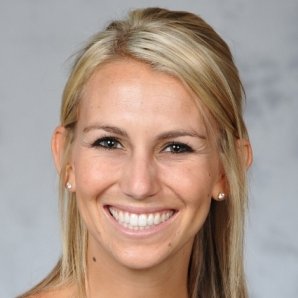
Lauren Lucido Watkins
Lauren has always been a strategic thinker and natural problem-solver. Lauren attributes her first venture into the realm of strategy and consulting as a core member for the Daily Bruin, first working as an intern, moving to internal advertising sales, and ultimately working as the assistant manager during her junior and senior years. In a time where the technological revolution was on the cusp of breaking through, Lauren and other members of the Daily Bruin were tasked with countering the demise of print paper and shift to online news platforms. While figuring out how to generate revenue beyond print and assessing the internal structure of the Daily Bruin, Lauren realized the importance of aligning your team with your business needs. Without a strong people strategy, she knew that business changes couldn’t follow. Lauren followed her passion, which culminated into an internship in Los Angeles with Deloitte Consulting in their Human Capital practice.
Lauren excelled as a top analyst while at Deloitte. She worked in their organization and talent group for two years before being approached by Christian Dior, who at the time was looking for business-minded candidates to take part in their re-launched management training program. Lauren knew that an opportunity in high fashion may not come again, so she decided to take a leap of faith, recognizing a greater end goal, and leave her job at Deloitte. Within a week, Lauren went from being a consultant advising clients, to working the floor at the Christian Dior Boutique on Rodeo Drive learning all facets of the luxury retail landscape. Such a drastic change in environment is no easy feat. Lauren believes her time spent at UCLA working at the Daily Bruin contributed to her successful transition between two very distinct worlds. She draws parallels between working at the Daily Bruin and her first work experiences at Christian Dior, both times in which she was a part of a group of people whose main focus was working as a team to grow the business in a fast-moving environment.
The Daily Bruin was not Lauren’s only extracurricular activity at UCLA. Lauren is a sister of Kappa Alpha Theta, serving as the Internal Social Chair and VP of Membership, and was the Consulting Director of the Undergraduate Business Society during her senior year. In terms of academics, her favorite class she took while at UCLA was Real Estate Investments, taught in tandem with professors and students from the Anderson School of Management. She has used many of the learnings to assess investments in her own life, including purchasing a home in San Francisco.
Upon transitioning to Christian Dior, Lauren spent one year in Beverly Hills focused on client development strategies and was then promoted to Christian Dior’s New York flagship where she was tasked at driving sales and overseeing the shoe department. Fast-forward to present day and Lauren has scaled the corporate ladder, now the Assistant Boutique Manager for the Christian Dior boutique in San Francisco, which she helped to open last year.
As a lover of high fashion myself, I was keen on hearing about how Lauren acquired such a vast knowledge of the high fashion realm in order to be working at one of the powerhouses in the industry. Her advice was to constantly stay active in obtaining knowledge and keeping an eye on the ever-changing landscape of fashion. I also asked her if there was any advice she wished she could say to her college-self. “Be fearless, take risks, and do [things] you’re passionate about.” Lauren reminded us that unless you put yourself out there, you can never truly reap the rewards from all the opportunities in life.
Written by Katie Kim, Undergraduate
Click here to see more Alumni Interviews.


Martin Hackmann featured in Bloomberg
/in News /by Simon BoardThis article in Bloomberg discusses Professor Hackmann’s work that studies the impact of nurses on mortality in hospitals and nursing homes.
John Asker wins Antitrust Award
/in News /by Simon BoardProfessor John Asker was awarded the “Best Antitrust Academic Article in Economics” by the Concurrences Antitrust Writing Awards for his article entitled “Diagnosing Foreclosure due to Exclusive Dealing” published in the Journal of Industrial Economics in September 2016.
The abstract is as follows: Exclusive dealing arrangements, in which a distributor contracts to work exclusively with a single manufacturer, can be efficiency enhancing or they can be an anticompetitive means to foreclose markets. This paper evaluates the effect of exclusive distribution arrangements on competition in the Chicago beer market in 1994. A diagnostic test is provided to judge whether exclusive arrangements between brewers and their distributors lead to foreclosure. To implement this test I estimate a model of consumer demand and firm behavior that incorporates industry details and allows for distribution through exclusive and shared channels. The test indicates that foreclosure effects are not present in this market, suggesting that the most likely effect of intervention would be to reduce social welfare.
Ph.D. Student Placement
/in News /by Simon BoardCongratulations to our Ph.D. students for their success in the job market. They will be heading to the following places:
Omer Ali: Analysis Group
Adrien d’Avernas: Stockholm School of Economics
Xue Hu: Amazon
Mat Miller: Amazon
Ruoyao Shi: UC Riverside
Chad Stecher: Rensselaer Polytechnic Institute
Colin Weiss: Federal Reserve Board
Sibo Yan: KPMG
Gabriel Zaourak: World Bank
Andreas Gulyas: University of Mannheim
Lauren Lucido Watkins
/in Alumni Interview /by Simon BoardEver since the 5th grade, Lauren Lucido Watkins knew she wanted to be a Bruin. There was no rhyme or reason, nor strong family legacy ties – Lauren was simply drawn to the prestige that came with the name and the energy that radiated from everyone who spoke about the university. Without ever considering a second option, she accepted her offer and graduated from UCLA in 2011 with a BA in Business Economics and a minor in Accounting.
Lauren Lucido Watkins
Lauren has always been a strategic thinker and natural problem-solver. Lauren attributes her first venture into the realm of strategy and consulting as a core member for the Daily Bruin, first working as an intern, moving to internal advertising sales, and ultimately working as the assistant manager during her junior and senior years. In a time where the technological revolution was on the cusp of breaking through, Lauren and other members of the Daily Bruin were tasked with countering the demise of print paper and shift to online news platforms. While figuring out how to generate revenue beyond print and assessing the internal structure of the Daily Bruin, Lauren realized the importance of aligning your team with your business needs. Without a strong people strategy, she knew that business changes couldn’t follow. Lauren followed her passion, which culminated into an internship in Los Angeles with Deloitte Consulting in their Human Capital practice.
Lauren excelled as a top analyst while at Deloitte. She worked in their organization and talent group for two years before being approached by Christian Dior, who at the time was looking for business-minded candidates to take part in their re-launched management training program. Lauren knew that an opportunity in high fashion may not come again, so she decided to take a leap of faith, recognizing a greater end goal, and leave her job at Deloitte. Within a week, Lauren went from being a consultant advising clients, to working the floor at the Christian Dior Boutique on Rodeo Drive learning all facets of the luxury retail landscape. Such a drastic change in environment is no easy feat. Lauren believes her time spent at UCLA working at the Daily Bruin contributed to her successful transition between two very distinct worlds. She draws parallels between working at the Daily Bruin and her first work experiences at Christian Dior, both times in which she was a part of a group of people whose main focus was working as a team to grow the business in a fast-moving environment.
The Daily Bruin was not Lauren’s only extracurricular activity at UCLA. Lauren is a sister of Kappa Alpha Theta, serving as the Internal Social Chair and VP of Membership, and was the Consulting Director of the Undergraduate Business Society during her senior year. In terms of academics, her favorite class she took while at UCLA was Real Estate Investments, taught in tandem with professors and students from the Anderson School of Management. She has used many of the learnings to assess investments in her own life, including purchasing a home in San Francisco.
Upon transitioning to Christian Dior, Lauren spent one year in Beverly Hills focused on client development strategies and was then promoted to Christian Dior’s New York flagship where she was tasked at driving sales and overseeing the shoe department. Fast-forward to present day and Lauren has scaled the corporate ladder, now the Assistant Boutique Manager for the Christian Dior boutique in San Francisco, which she helped to open last year.
As a lover of high fashion myself, I was keen on hearing about how Lauren acquired such a vast knowledge of the high fashion realm in order to be working at one of the powerhouses in the industry. Her advice was to constantly stay active in obtaining knowledge and keeping an eye on the ever-changing landscape of fashion. I also asked her if there was any advice she wished she could say to her college-self. “Be fearless, take risks, and do [things] you’re passionate about.” Lauren reminded us that unless you put yourself out there, you can never truly reap the rewards from all the opportunities in life.
Written by Katie Kim, Undergraduate
Click here to see more Alumni Interviews.
Recruiting Talent
/in Research Spotlight /by Simon BoardMortiz Meyer-ter-Vehn
The success of most firms is built upon hundreds of individuals who take thousands of decisions, making it critical to identify and recruit the best talent. Such human capital is a key source of competitive advantage in a wide range of industries, from service to technology. For instance, the standing of a university depends more on the quality of its professors than on its real estate. Talent is also critical for consultants, salesmen and firms like Netflix, whose human resource manual states “One outstanding employee gets more done and costs less than two adequate employees. We endeavor to have only outstanding employees”.
Differences in talent across firms perpetuate through hiring because talented managers have better judgment and better information. For example, in academia, a star professor can easily evaluate the quality of an applicant’s research. And, at Netflix, talented managers can use their professional connections to investigate a potential recruit.
Simon Board
Based on these tenets – that talent matters and perpetuates through hiring – professors Simon Board, Moritz Meyer-ter-Vehn, and Tomasz Sadzik propose a new model of firm dynamics in their working paper entitled “Recruiting Talent”. The key contribution of the paper is to place talent at center stage, in comparison to traditional models of firm dynamics that characterize firms through their stock of capital or labor. The resulting model generates persistent differences between firms’ talent, productivity and wages, consistent with the large dispersion found in the empirical literature. A firm’s stock of talent thus gives it an advantage in identifying future talent and provides a sustainable competitive advantage.
Tomasz Sadzik
The first step in the analysis is to show that firms with many talented employees optimally pay high wages and attract the best applicants. Intuitively, skilled recruiters have a comparative advantage in hiring from a high-wage applicant pool with a balance of talented workers, rather than hiring from a low-wage pool in which few talented applicants remain. If firms start off initially similar then, over time, better endowed firms accumulate talent, while the worse endowed hire from poor, deteriorating applicant pools and lose talent. Countering this is the natural regression to mediocrity that results from noise in the hiring process. The economy then converges to a steady state that exhibits persistent heterogeneity in wages, talent and productivity where these two forces offset each other. While low-quality firms could in principle catch up by posting higher wages and hiring more talented workers, it is not profitable for them to do so.
Building on this model, the paper generates a rich set of predictions. An increase in screening skills, say, due to technological innovation, raises the dispersion of wages and the segregation of workers across firms, helping to explain recent trends documented in the empirical literature. The paper also cautions against splurging on “super-stars” for firms that wish to rise in the rankings. The authors show that such a strategy may be a waste of money when the current organization lacks the capabilities to identify the stars of tomorrow; a gradual increase in wages is preferable. Finally, the results show that welfare is increased by policies that reduce wage inequality, lowering the dispersion of talent and the segregation of workers across firms.
Adriana Lleras-Muney in the Washington Post
/in News /by Simon BoardProfessor Adriana Lleras-Muney was quoted in the Washington Post in a story about the stagnating life expectancy in America. This article is based on a conference at the Brooking Institution.
Michela Giorcelli wins Cole Grant
/in News /by Simon BoardProfessor Michela Giorcelli was awarded the Cole Research Grants-in-Aid for post-Doctoral Research by the Economic History Association for her project on “The Marshall Plan and the European and US Economies After WWII”. The Cole Grants are annually awarded to recent Ph.D. recipients to support research in economic history.
Danwei Chen
/in Uncategorized /by admin2016 Robert D. & Margaret A. Wark Memorial Scholarship Recipient
Biography: Danwei Chen is a third-year student at UCLA pursuing a major in Economics and minor in Accounting. Having completed elementary through high school in Wisconsin, she is enjoying discovering all that Los Angeles has to offer. Danwei currently works for the Laurence and Lori Fink Center for Finance & Investments within the UCLA Anderson Graduate School of Management, where she has learned much about the finance industry. She is passionate about community involvement and serves as Vice President-Operations of Colleges Against Cancer at UCLA, the collegiate extension of the American Cancer Society. Danwei recently studied abroad at the London School of Economics, during which time she took courses in finance and economics and fostered her passions for travel and global cultures. She also likes to spend time hiking, playing/watching tennis, and trying new foods.
Future Plans: Danwei is excited about the applications of her education and is working towards a career in finance. This summer, she will be completing a Summer Analyst position at Pacific Alternative Asset Management Company in Irvine, California. She hopes to work full-time in the investment management field upon graduation and eventually pursue a Master’s in Business Administration.
What does the scholarship mean to me?: I feel incredibly honored to be selected as a recipient of the Robert D. and Margaret A. Wark Memorial Scholarship. I am extremely grateful to the Wark Family for their generosity in supporting my education. With this scholarship, I’m able to focus more time and effort on academic, professional, and extracurricular pursuits. I’m touched by the Wark Family’s giving values and hope to someday pay it forward to future generations of Bruins. In the meantime, I will strive to honor this recognition by continuing to work hard in the remainder of my time at UCLA and the start of my career.
NBER Profile on Till von Wachter
/in News /by Simon BoardThe National Bureau of Economic Research featured Professor Till von Wachter in it’s biannual Bulletin on Aging and Health.
Econ Major named PAC 12 All-Academic
/in News /by Simon BoardUCLA basketball center Tom Welsh and Economics major is named as PAC 12 All-Academic. Starting at 51:40, he talks about his favorite class (intermediate microeconomics!) and UCLA Basketball on the Bruin Insider show.